0
-
An empty cart
You have no item in your shopping cart


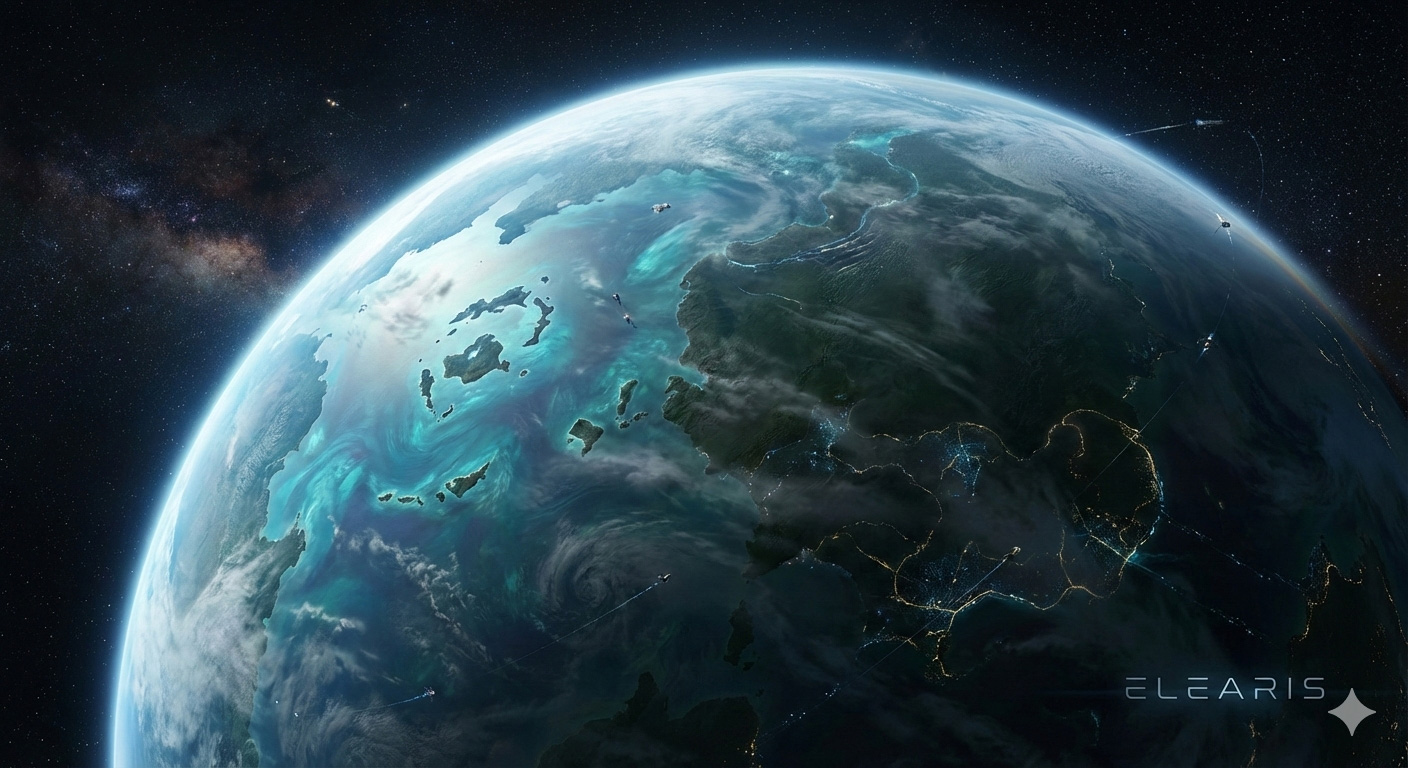
Elearis is a planet located in the Milky Way and constitutes the political, economic, and strategic core of the known civilised universe. It hosts the Congress of the UPC, the institution from which many of the decisions affecting allied and dependent systems are articulated. For this reason, Elearis is considered de facto the capital of the civilised universe, not only because of its institutional status, but due to its real capacity for influence.
In its earliest era, the planet was inhabited exclusively by the Elearians, the native species that shaped its history, culture, and subsequent expansion.
In its primordial stage, the surface of Elearis combined vast iridescent oceans, floating archipelagos, and continents covered by dense, exuberant forests. Over millennia, an animal species gradually evolved into a rational humanoid race, possessing DNA remarkably similar to that of Terran humans. From this process, the Elearians emerged.
Urban, industrial, and technological growth progressively transformed the planet’s surface. Uncontrolled urban expansion and intensive resource exploitation pushed Elearis to the brink of global ecological collapse, a situation that coincided with a severe biological crisis threatening the very continuity of the dominant species.
Following Xarelite intervention (a nomadic species originating from another galaxy), Elearis redefined its relationship with its own environment. Today, the planet preserves Protected Natural Cores, vast areas where original life forms are strictly conserved. The oceans remain a key source of energy and biological resources, cultivated and managed under controlled systems, while aggressive extraction has been displaced to planets in neighbouring systems, reducing direct pressure on the core world.
Elearians possess a morphology closely resembling that of humans, although their skin displays paler and bluish tones, a feature directly linked to the colour of their blood, which is blue. This trait is not merely aesthetic, but the result of an advanced physiology and a highly adaptive genetic structure.
They exhibit superior resistance to disease and toxins, as well as a regenerative factor significantly higher than that of most humanoid species. This advantage, however, carried an unexpected cost.
The accelerated adaptive capacity of Elearian DNA, which had driven their evolution exponentially for centuries, ultimately triggered a state of global genetic instability.
The accelerated evolution of Elearian DNA led to a planet-wide genetic pandemic. Its manifestations were extreme and deeply disturbing: unexplained deaths, severe physical degeneration, and in the most critical cases, the fusion of bodies into amorphous masses of flesh and bone, later classified as biological aberrations.
The crisis pushed Elearian civilisation to the edge of extinction and forced the search for a solution beyond its own scientific limits.
The civilisation of Xárel, with which Elearis already maintained contact, intervened decisively. Their scientific contribution stabilised Elearian DNA through controlled integration with Terran DNA.
Terrans, regarded as an older and less evolved version of humanity, possessed a far more stable genetic baseline. The result was the creation of a hybrid Elearian–Terran lineage, genetically viable and controllable, ensuring the long-term survival of the species.
This process, however, carried profound ethical, social, and political consequences.
Following the Xarelite intervention that stabilised the Elearian genetic crisis, Xárel and Elearis forged a strategic alliance that marked a decisive turning point in the history of both civilisations. The combination of advanced Xarelite scientific knowledge and Elearian organisational and expansionist drive triggered an unprecedented era of development.
From this cooperation emerged key discoveries, including Chronodium and the development of space-temporal jump engines, technologies that enabled systematic colonisation of other star systems and sustained expansion beyond the home world.
As a direct result of this new phase, the United Planets Confederation (UPC) was created, a supraplanetary structure designed to coordinate expansion, administration, and coexistence among colonised worlds. Its Congress, established on Elearis, brings together representatives of the member planets, consolidating the planet’s role as the political centre of the civilised universe.
As a preventive measure following the global genetic crisis, Selective Gestation Centres were imposed on a planetary scale. These institutions exert strict control over the genetic development of the population from the very moment of gestation, becoming one of the central mechanisms of demographic and biological regulation on Elearis.
The reproductive cells of individuals conceived through the GSM system remain in a latent and inactive state indefinitely, rendering them completely ineffective for natural reproduction. Reactivation is only possible through specific chemical processes employed exclusively during authorised gestation procedures in embryonic stations. As a result, only the system itself is legally and biologically authorised to procreate new citizens, always in vitro, who are then educated and prepared to integrate into Elearian society.
This absolute control responds to a structural necessity: due to their extreme resistance to death, disease, and environmental hazards, the Elearian population would otherwise grow exponentially within a few decades, once again collapsing planetary and adjacent system resources. At the same time, the Selective Gestation Centres prevent uncontrolled mutations and the re-emergence of biological aberrations linked to past genetic instability.
Nevertheless, the extraordinary adaptive capacity of Elearian DNA, combined with the need to colonise and survive in alien ecosystems, has driven the Centres beyond simple containment. In specific contexts, new Elearian variants have been developed by integrating genetic material from semi-compatible local species, such as the Sunarani, Aquanites, and other indigenous races from colonised worlds.
Although initially presented as an unavoidable medical and evolutionary solution, the Selective Gestation Centres have become one of the most controversial pillars of the Elearian system. For some, they represent the salvation of the species; for others, the ultimate symbol of institutional control over who may be born, how, and for what purpose.
Elearis is a highly advanced, industrialised, and moderately militarised civilisation. It stands at the peak of its technological development, a status closely linked both to contact with Xárel —which opened new scientific, technological, and genetic pathways— and to the discovery of Chronodium and space-temporal jump engines, the pillars of its expansion and dominant position.
Elearian cities are organised into clearly differentiated vertical strata. In the upper levels, clean air and open skies belong to skyscrapers, elevated plazas, and floating parks arranged in near-harmonic order, where natural light and precision engineering define the urban landscape.
Below, in the lower levels, the city becomes chaotic. A disordered urban engineering of alleys, tunnels, and drainage systems spreads like an oppressive network, barely reached by daylight. The air grows dense and difficult to breathe, saturated with stench and pollution, reflecting a social and structural reality that stands in brutal contrast to the cleanliness of the heights.
Elearian society is deeply stratified. The political class, major traders, and above all the corporations enjoy privileged living conditions and concentrate the true levers of power. In contrast, the middle and lower classes survive under precarious conditions, trapped within a system that prioritises productivity, economic efficiency, and profitability over individual or collective welfare.
Over centuries, corporations have woven a transversal network of influence that directly shapes political decisions, military strategies, exploratory missions, colonisation processes, and conquest campaigns. The economy of Elearis depends almost entirely on these industrial, technological, and mining giants, to the point where the boundary between institutional authority and corporate power is, in practice, indistinguishable.
Population integration is structured through a system of centralised gestation and education. New citizens are conceived through controlled processes and raised within embryonic stations, receiving uniform training until adolescence. At that stage, they are evaluated and assigned to specialised academies according to their aptitudes, in order to fulfil the structural needs of Elearian society.
Those who succeed gain access to a regulated but stable existence within the system. Those who fail selection, or who later neglect their social obligations, are classified as “Free Citizens”, a term that masks a drastic loss of rights and institutional protection.
Some choose to emigrate to colonial worlds, where they may begin a new life as settlers or workers under different legal frameworks. Others are relegated to the lower levels of Elearian cities, inhabiting degraded, overcrowded zones far removed from the elevated environments where order and privilege are concentrated.
The result is a functional yet profoundly unequal society, in which one’s position depends less on personal choice than on the value assigned to each individual within the system.